
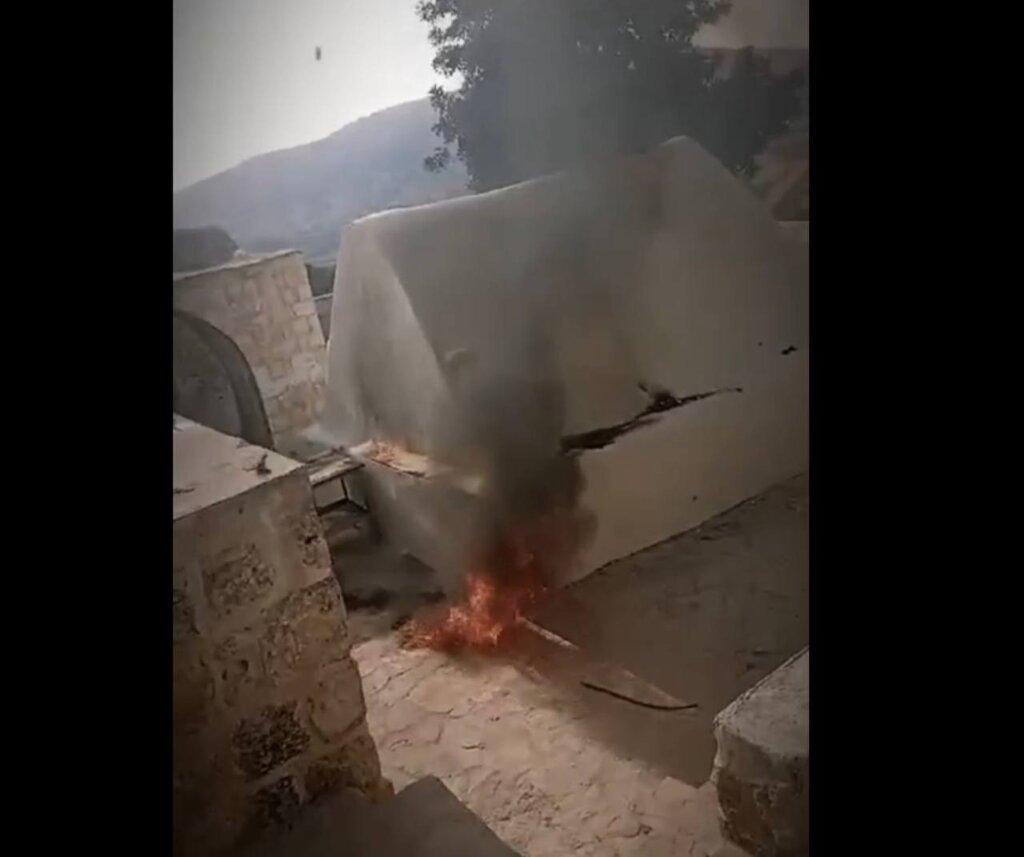
On the night of October 20–21, 2026, Arabs from the village of Awarta in Samaria set fire to the tomb of Eleazar, son of Aaron the High Priest, one of the region’s Jewish holy sites. Footage of the arson was circulated on Arab social media, accompanied by songs glorifying the act and threatening messages.
The video circulated online included the following Arabic text:
“What comes next will be even bigger, you scoundrels
Awarta, the Red Fortress”
The village of Awarta, located southeast of Nablus (Shechem), is traditionally identified in Judaism as the burial place of several prominent biblical figures, including Eleazar and Ithamar, the sons of Aaron the High Priest, Phinehas, the son of Eleazar, and the 70 Elders of Israel. These burial traditions were documented by Jewish travelers as early as the Middle Ages.
According to the Bible, Eleazar succeeded his father as High Priest and continued serving in that role during the time of Joshua. The Book of Joshua (24:33) states:
“And Eleazar the son of Aaron died; and they buried him in the hill of Phinehas his son, which was given him in Mount Ephraim.”
According to Jewish tradition, the Hill of Phinehas is identified with the site in Awarta.
The village also contains the traditional tomb of Ithamar, Eleazar’s brother and Aaron’s youngest son, who likewise held important priestly responsibilities in the Tabernacle. Nearby is the traditional tomb of Phinehas, Eleazar’s son.
Another Jewish holy site in Awarta is the Tomb of the 70 Elders, traditionally associated with the elders of Israel who participated in the leadership of the Jewish people during the time of Moses and Joshua. The 70 Elders were appointed to assist Moses in leading the Israelites, and this institution is regarded in Jewish tradition as one of the earliest foundations of the Sanhedrin.
The arson comes approximately five months after another desecration of a Jewish holy site in the same village. On May 11, 2026, it was discovered that Arabs from Awarta had vandalized the Tomb of the 70 Elders.
During that incident, a flag belonging to the Popular Front for the Liberation of Palestine (PFLP) terrorist organization was raised over the compound, while graffiti glorifying the October 7 massacre was sprayed on the tomb’s walls, including the inscription:
“October 7 Is a Legendary Day.”
Following the desecration, Israeli security forces entered the village, removed the terrorist organization’s flag, and erased the inflammatory graffiti from the walls of the compound.
Now, just months after the desecration of the Tomb of the 70 Elders, another attack on a Jewish holy site has been documented in the same village — this time, the arson of the tomb of Eleazar the High Priest.
Questions and Answers
What Happened in Awarta?
Arabs from the village set fire to the tomb of Eleazar the High Priest and circulated footage of the arson on Arab social media, accompanied by songs and threatening messages.
Who Was Eleazar the High Priest?
Eleazar was the son of Aaron the High Priest, the nephew of Moses, and the successor to his father as High Priest. He continued serving in this role during the time of Joshua. According to Jewish tradition, he was buried on the Hill of Phinehas, traditionally identified with the site in Awarta.
Who Were the 70 Elders?
The 70 Elders were leaders appointed to assist Moses in governing the people of Israel, as described in the Book of Numbers. According to Jewish tradition, they formed one of the earliest foundations of the Sanhedrin, the ancient Jewish judicial and religious council. A burial site in Awarta is traditionally attributed to these biblical elders.
What Happened at the Tomb of the 70 Elders in May?
On May 11, 2026, it was discovered that Arabs from the village had desecrated the site. Graffiti glorifying the October 7 massacre was sprayed on its walls, and a flag of the PFLP terrorist organization was raised over the compound.
What Is the Connection Between the Two Incidents?
Both incidents occurred in the village of Awarta in Samaria, approximately five months apart, and both targeted sites sacred to Judaism. It is not known whether the same individuals were involved in both incidents.